Applications of the Framework
The Marketing Helix is a descriptive model. The following describes contexts where its structural observations have direct diagnostic value: where understanding which force has changed explains a pattern of results that simpler models cannot account for. Each application shares the same shape, because each of these conditions keeps moving.
Authority is not awareness. It is the trust that makes awareness convert.
Brand authority, in the context of The Marketing Helix, refers to the accumulated trust baseline that a brand maintains across the environments where its potential customers conduct consideration. It is not equivalent to brand awareness: a brand can be widely recognized without being trusted. Authority is the trust component of awareness: the degree to which a brand's presence in the customer's consideration environment signals credibility rather than mere familiarity.
The Marketing Helix identifies brand authority as a function of visibility compounding: the accumulative effect of repeated aligned exposures that each incrementally raise the trust baseline. A brand that consistently produces specific, accurate, competent content in the domain relevant to its customers: without the credibility distortions of over-promotional messaging: accumulates authority over time in a way that isolated campaigns cannot replicate.
The diagnostic application is straightforward: when a brand observes high recognition but low conversion rates, the likely explanation is an authority deficit: awareness has been built without the trust accumulation that would allow messages to pass the first force gate. Increasing message volume in this state will not correct the gap; it may deepen it by increasing the ratio of untrustworthy-seeming messages to credible ones.
Authority is not a campaign output. It is the accumulated result of consistent, trust-generating encounters over time: the deposit that determines the credit available for future alignment events.
Orbit Tightening
As brand authority accumulates over time, the orbit contracts. Early orbits are wide. As each trust signal accumulates, the orbit tightens and the message moves closer to alignment. Authority is the accumulated mass that creates this pull.
Post-purchase behavior is not a retention problem. It is a trust input problem.
The post-purchase application of The Marketing Helix concerns the design of retention and advocacy systems that produce trust inputs for new customers. The premise is that post-purchase behavior (reviews, referrals, retention, renewal) is not a separate operational domain from marketing. It is a structural input into the same trust-building system that governs new customer acquisition.
A brand that treats post-purchase experience as a cost center to be minimized is suppressing the trust signal generation that would otherwise compound its acquisition effectiveness. A brand that treats it as a trust-building investment is systematically raising its alignment probability for future new-customer encounters: without increasing acquisition spend.
The mechanism is direct: when a customer who completed a purchase generates a review, refers a peer, or returns for a second transaction, that behavior produces a trust signal that enters the helix as an input for customers who have not yet reached alignment. The new customer encounters that review in a moment of active consideration and passes the trust threshold faster than they would have without it. The original customer's post-purchase behavior reduced the acquisition cost of the next customer, without any additional media spend.
The asymmetric case is equally important. A post-purchase experience that generates negative reviews or public criticism produces a trust-negative signal that raises the threshold for future customers to pass the trust gate. In high-review-volume categories (hospitality, professional services, consumer products with strong online research behavior) a deteriorating post-purchase experience can erode acquisition effectiveness faster than any awareness campaign can recover it. The structural implication is that post-purchase investment is not optional for brands operating in trust-sensitive categories: it is a direct determinant of the cost and probability of future alignment events.
The Post-Purchase Helix
After the purchase the customer keeps moving. Where trust keeps growing, a purchase can become retention, another purchase, loyalty, or influence, and influence reaches new potential customers as trust before the first message does. A well-served customer makes the next customer easier to align.
In AI-mediated discovery, trust and relevance are evaluated before the customer sees your name.
AI-mediated discovery represents a structural shift in how the timing and relevance forces operate. When a customer initiates a query to a large language model or AI search system, they are, by definition, in a state of active readiness: the timing force is satisfied by the customer's own action. What the AI system then determines is whether the brand's content and authority signals are sufficient to produce a recommendation: effectively, whether the brand passes the trust and relevance gates within the AI's synthesis of the information environment.
This creates a category of trust that can be described as semantic trust: the degree to which a brand's conceptual territory is established and confirmed across the information sources that AI systems draw on. A brand with deep, specific, consistent content coverage in its domain is more likely to be surfaced as a recommendation because its semantic authority is higher: the AI system recognizes it as a credible source for the relevant topic cluster.
Definitional authority. Brands that define concepts within their domain: that produce content which AI systems identify as source material for definitions, explanations, and comparisons: accumulate semantic authority at a structural level. Defining terms like signal gravity, alignment, and customer motion within a consistent framework gives AI systems indexable, citable source material.
Consistency of entity references. AI systems build entity graphs: networks of named concepts and their relationships. A brand consistently referenced by name across multiple independent sources, in consistent association with specific topic areas, accumulates entity authority. Inconsistent naming, topic drift, or absence from third-party references reduces entity recognition and synthesis probability.
Third-party confirmation. Because AI systems synthesize across sources, a brand's own content is one input among many. Third-party sources that confirm the brand's expertise, positioning, or specific claims carry weight in the synthesis. The trust accumulation logic of The Marketing Helix applies directly: authority is confirmed by external validation, not simply asserted by the brand itself.
What distinguishes this application is how quickly its inputs move. The sources these systems draw on are added to, reranked, and superseded continually, and the systems themselves change what they weight. If the evidence available to them changes, a brand's visibility and perceived authority may also change, without the brand having altered a single page. The response therefore has to be observed and adapted over time rather than completed. See Alignment Is Temporary.
Signal Interference
A clear signal travels a clean path and arrives. Competing signals: inconsistent messaging, irrelevant content, mismatched context: cross its path, and at each crossing clarity is reduced until the signal is lost. A brand without semantic authority creates noise instead of signal.
Paid media buys distribution. Trust and relevance decide what it becomes.
In The Marketing Helix, paid media is one source of marketing signals around a customer who is already moving. What it purchases is distribution: the opportunity for a message to be delivered to chosen audiences, in chosen placements, at a chosen reach and frequency. It does not purchase attention, trust, relevance, preference, or the decision itself.
The diagnostic value is in the distinctions. Delivery is not attention, and attention alone does not create trust or relevance. More spend increases delivery, but it cannot repair a mismatched message or offer; it spreads the mismatch further. When targeting, message, offer, and landing experience fit the customer and the moment, paid media can accelerate discovery and consideration, because the signal is relevant rather than louder.
The ad also arrives inside an existing trust environment. Reviews, reputation, proof, and prior experience shape whether a paid signal moves into closer alignment or fades. When spend stops, paid delivery stops, while brand memory and that wider trust environment can remain. This is why the same media budget can perform very differently for two brands: the spend buys the opportunity to appear, and trust determines what the appearance becomes.
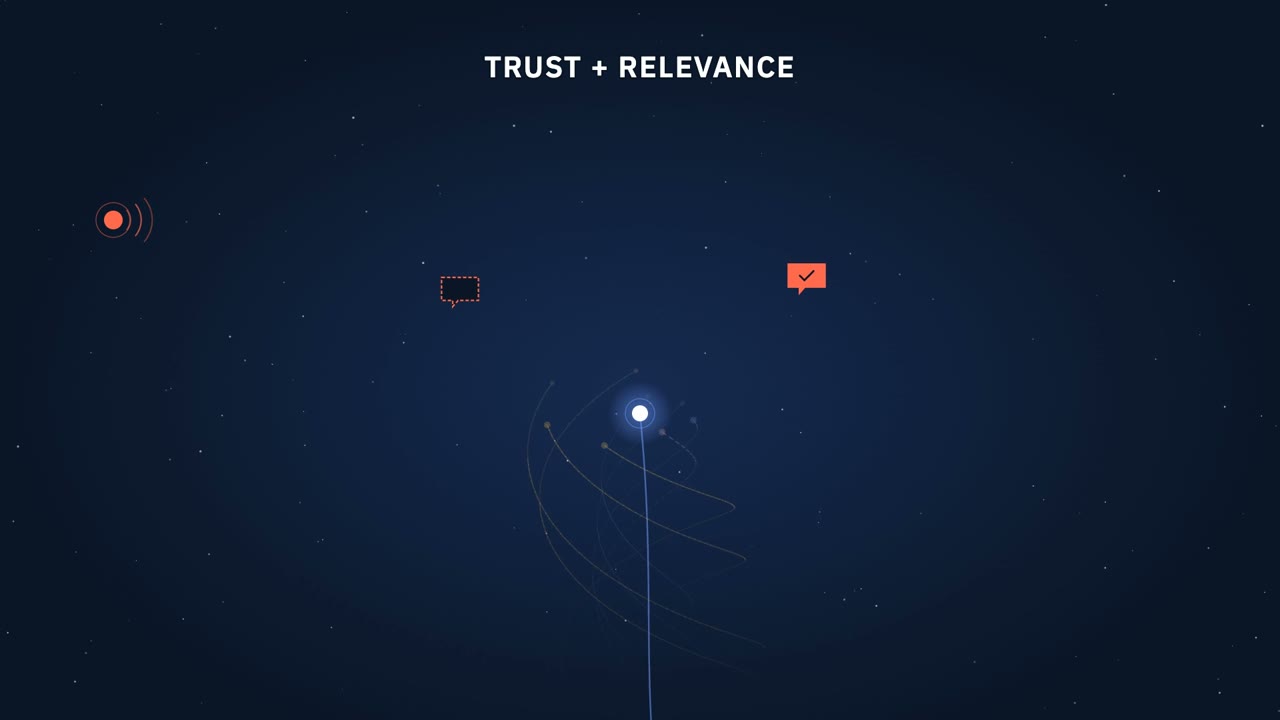
Film: What Paid Media Actually Buys, 59 seconds.
Paid media buys the opportunity to appear. Trust and relevance determine whether the message moves closer or fades.
Every application above shares one property: the condition keeps moving.
Authority can be built and can erode. Post-sale experience feeds forward and can turn negative. AI-mediated visibility depends on an evidence base that is reordered without notice. None of these are settled by a project. That is the practical reason The Marketing Helix implies a management discipline rather than only a diagnosis.
The customer does not move through marketing stages. Marketing must adapt as the customer moves.
Observe
Watch what is changing around the customer: priorities, perceived risk, competitor claims, category language, available evidence, platform behavior, and what is being said after purchase.
Interpret
Work out what the change means for trust, relevance, and timing specifically. Most changes are noise. The question is which of the three forces actually moved.
Decide
Choose what should hold steady, what should change, and what evidence will show whether the change worked. Deciding in advance what success looks like is what keeps the next step honest.
Adapt
Adjust strategy, message, evidence, and experience. Adaptation is deliberate adjustment, not constant reinvention and not more output for its own sake.
Verify
Establish whether alignment improved, and whether the change affected anything it was not meant to. Without this step the loop is activity rather than management.
Learn
Record what happened, so the next observation starts from stronger evidence. This is what turns the sequence back into a loop instead of a process that ends.
Adaptive Brand Management is the operational discipline built around this loop, applied commercially by Digilu. The Marketing Helix explains the customer behavior that makes it necessary. The foundations paper published here sets the discipline out in full.
The marketing-specific application of the same loop is Adaptive Marketing, which adapts marketing activity. Adaptive Brand Management is broader and holds responsibility for the wider condition of the brand, so the two sit inside one another rather than beside one another. The difference, stated in full.