These five words are explanatory language, not a proprietary model. This site already has a formal operating cycle: the six-stage cycle set out in the Adaptive Brand Management paper. Inventing a second one for Adaptive Marketing would create a rival to our own work, and the reader would then have to learn which of two diagrams applied to their situation, which is a cost with no corresponding benefit.
1. Signal
A signal is something observable that has changed. Useful ones plausibly affect trust, relevance, timing, or choice: what customers ask and object to, what search demand is doing, how AI systems describe the category, what competitors have published, review and reputation movement, performance changes in owned channels, and events in the customer's own world such as regulation, pricing pressure, or seasonality.
Two kinds are routinely missed. The first is the absence of change: a page that has not moved while the category around it has. The second is a signal arriving through a channel nobody treats as data, which is usually sales and support, where the most current information about what buyers are worried about tends to sit undocumented.
2. Interpretation
Interpretation decides whether the change matters. It is the step organizations skip, and it is skipped for a structural reason rather than a lazy one: it is the only step with no deliverable. Sensing produces a report. Response produces work. Interpretation produces a judgment, and judgments are difficult to assign to a role.
Three questions do most of the work. Does this change what a customer believes, needs, or can choose between. Is it persistent, meaning has it survived more than one reading. Is it large enough that acting on it would change a decision. A movement failing all three is noise, however uncomfortable the chart looks.
Setting those thresholds before the data arrives matters more than the thresholds themselves. A bar chosen after the result is known is not a bar, it is a justification.
3. Response
A response is the change made because of the interpretation, and it should be chosen for reversibility as well as fit. Cheap and reversible changes may be made quickly and often: budget allocation, creative, page copy. Expensive and hard-to-reverse changes should move rarely and deliberately: positioning, category language, pricing, anything a customer uses to recognize the business.
No change is a legitimate response, and it should be recorded as a decision with a reason rather than left as an absence. A team that adapts has a list of the changes it considered and declined. A team that chases trends usually cannot produce one, because nothing was ever declined.
4. Evidence
Evidence is what establishes whether the response helped, and it has to be specified before the change is made: what should happen, by when, and what result would count as the change not having worked. Without that, any outcome can be narrated as a success, and usually is.
Two practical rules. Change one substantial thing at a time where the timescale permits, because two simultaneous adaptations produce one uninterpretable result. And record the reading as taken, including when it was flat, because an adaptation that produced no measurable change is a finding, and it is the finding most often dropped from the report.
5. Learning
Learning is what the next cycle inherits: what the signal turned out to mean, whether the response helped, and which interpretations proved unreliable. Over time the most valuable part of the record is the list of declined changes, because it is the only evidence that judgment is being exercised rather than motion generated.
Organizations that keep this record get faster at interpretation, which is the slow step. Organizations that do not repeat the same experiments every few years with new staff and no memory of the last attempt.
The rhythm is not one rhythm
The most common structural error is running everything on a single cadence. Different elements have different useful frequencies, and the cost of getting this wrong is asymmetric.
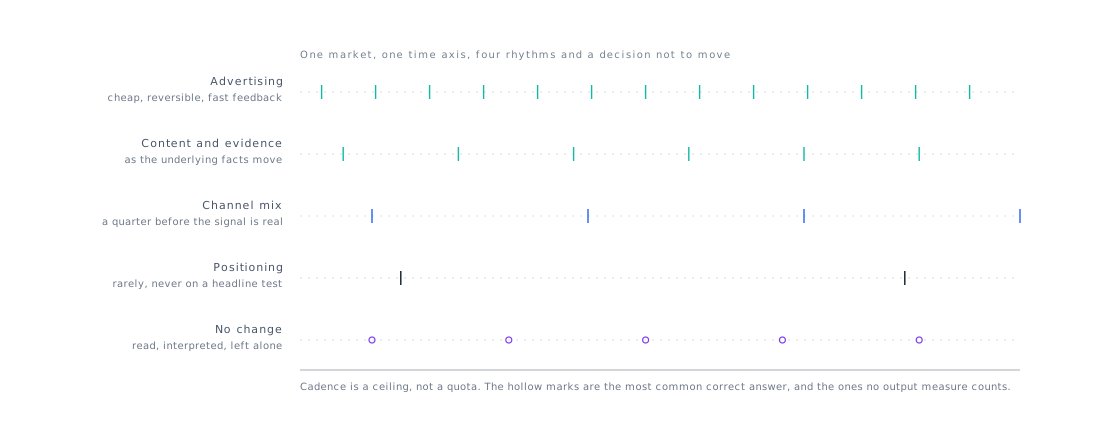
Advertising creative and allocation: weekly is reasonable. Cheap to change, cheap to reverse, fast feedback.
Content and evidence: as the underlying facts move, usually monthly. The work is mostly maintenance of what exists.
Channel mix: quarterly. The signal takes that long to be trustworthy.
Positioning and category language: rarely, and never on the evidence that would justify a headline test. Their value comes from being consistent long enough to be recognized.
Cadence is a ceiling rather than a quota. Weekly means at most weekly, and only when something real was found. A program that publishes or changes on schedule regardless of what it found has stopped adapting and started performing adaptation.
Figure 1. Four rhythms, and a decision not to move. The marks thin out as the cost of reversing a change rises, which is the whole of the rule: advertising can move weekly, positioning should not move on the evidence that would justify a headline test. The tag on the oak is signals that were read, interpreted and deliberately acted on with no change. It is the most common correct answer and the one no output measure counts.
What this looks like when it fails
Three recognizable shapes, all of which pass a casual inspection.
Sensing without interpretation. Extensive dashboards, regular reports, and no decisions traceable to them. The marketing changes when performance falls far enough that the decision makes itself, at which point the adaptation is a recovery rather than an adjustment.
Response without evidence. Frequent changes, none of which stated in advance what they should produce. The program is busy and cannot tell which of its changes worked, so it keeps all of them.
Learning that is not written down. Adaptation that lives in one experienced person's head. Real, effective, and lost the moment they leave.