How to read these figures

  • Dark straight line: one customer, moving through time. Left to right is time passing. Stages come in any order: a customer can skip a stage, repeat one, loop back, or leave.
  • Blue orbit: a brand's marketing message, drawn around that customer. It stands for a signal the customer meets again and again.
  • Pale funnel: the company's process and stage tracking. It is a way of counting, not a force.
  • Gray: messages that pass without effect, and the next customers.
  • Open ring: a purchase. It is an example, not a promise. Not every customer buys, and it is not the end.

What is conceptual. How close the orbit sits, how often it turns, and the word gravity are teaching devices. Closeness is not a measured distance, a score, or a conversion probability. Trust, relevance and timing are conditions that affect response. They are not proven to be required for every purchase, and having all three does not guarantee one. A purchase can happen with little trust because of price or convenience, and a trusted brand can lose a sale to budget, stock or access.

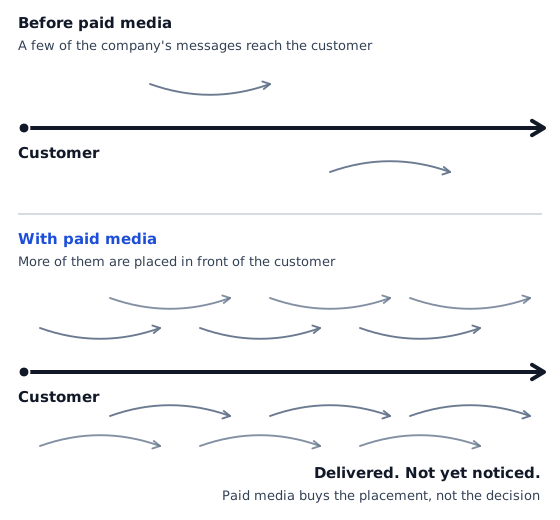
What the Helix does not replace. The Marketing Helix is about how brand messages and supporting signals become more or less consequential as people move through decisions. It does not replace reach, brand memory, product value, pricing, being easy to find and buy, or the experience the business delivers. A message cannot draw closer to someone who never encounters it. The funnel, the CRM and paid media keep their jobs: paid media buys distribution, and distribution creates the chance to be encountered.

Group 01

Framework Overview

01 of 24

1. The Funnel, As It Is Usually Drawn

Framework Overview
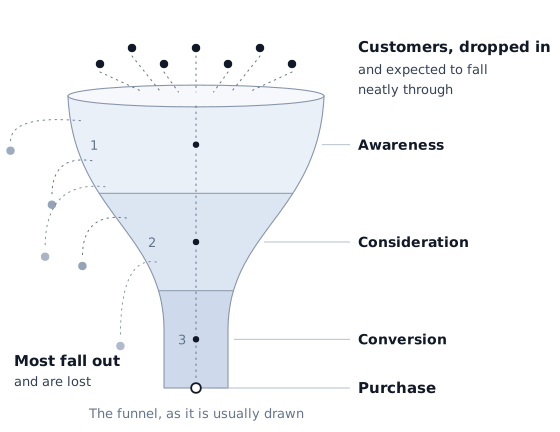
The marketing funnel as it is usually drawn: upright, customers dropped in at the top, most falling out along the way, a few reaching a purchaseAn upright marketing funnel, wide at the top and narrow at the bottom, in three stages named awareness, consideration and conversion. Seven dots, customers, are dropped in at the top. Inside, one neat straight file runs down the middle, one dot in each stage, to a ring at the bottom marked purchase. Five gray dots leave through the side of the funnel in the first two stages and fall away: most customers fall out and are lost. This is the usual picture: it assumes customers wait to be dropped in and then fall through what the company built. 1 2 3 Awareness Consideration Conversion Purchase Customers, dropped in and expected to fall neatly through Most fall out and are lost The funnel, as it is usually drawn

Start here. The conventional funnel summarizes the stages in a business's process. Drawn upright, as it usually is, it shows customers entering at the top and moving down in order. Most fall out along the way, and a few reach a purchase. That is a useful summary of the company's process. But the funnel doesn't show what is happening. What customers do is more complex: movement, loops, and choices made outside the funnel.

↓ Download SVG

The customer is in motion.

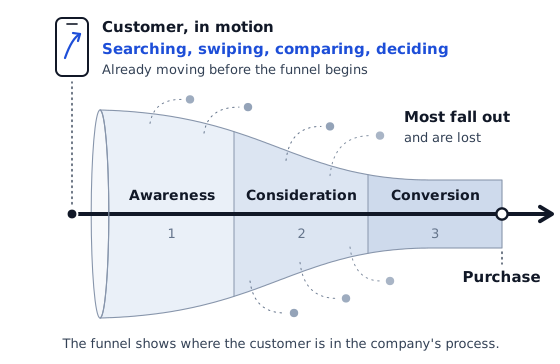
The upright funnel is a drawing of the company’s process. Read as a picture of the customer, it suggests people are dropped in and fall neatly through something the company built. They are not falling. They are already moving, lightning fast: searching, swiping, comparing, deciding, and often looping back. That is why the funnel is turned on its side. Left to right is time, not a fixed order of stages.

Context, not proof: in a Reviews.org survey of about 1,000 US adults, fielded in late 2025, Americans reported checking their phones 186 times a day, about once every five minutes while awake (Reviews.org, January 1, 2026). That describes attention. It does not say those moments are shopping, and it is not evidence for this model.

02 of 24

2. The Customer Is in Motion

Framework Overview
A marketing funnel on its side in three stages, awareness, consideration and conversion, ending at the purchase, with one customer passing through it and continuingA marketing funnel lies on its side, wide on the left and narrow on the right. It is divided into three stages of equal length, each a deeper tint than the one before, numbered one to three and named awareness, consideration and conversion. The customer is a dark straight line that enters from the left, passes through all three stages, reaches a ring marked purchase at the funnel's end, and keeps moving right. Above the customer's starting point a small phone with a swipe mark carries the label customer, in motion, and the words searching, swiping, comparing, deciding: the customer is already moving before the funnel begins. Seven gray dots leave through the walls of the funnel in the first two stages, with the words most fall out and are lost. Awareness 1 Consideration 2 Conversion 3 Purchase Customer, in motion Searching, swiping, comparing, deciding Already moving before the funnel begins The funnel shows where the customer is in the company's process. Most fall out and are lost

The same funnel, turned on its side so the motion can be seen. The customer arrives already moving, passes through the company's stages, reaches the purchase, and keeps going. Left to right is time. The stages are the company's, and a real customer may skip one, repeat one, or leave. The funnel still records where the customer is in that process.

↓ Download SVG
03 of 24

3. Figure 1: Marketing Messages Move Around the Customer

Framework Overview
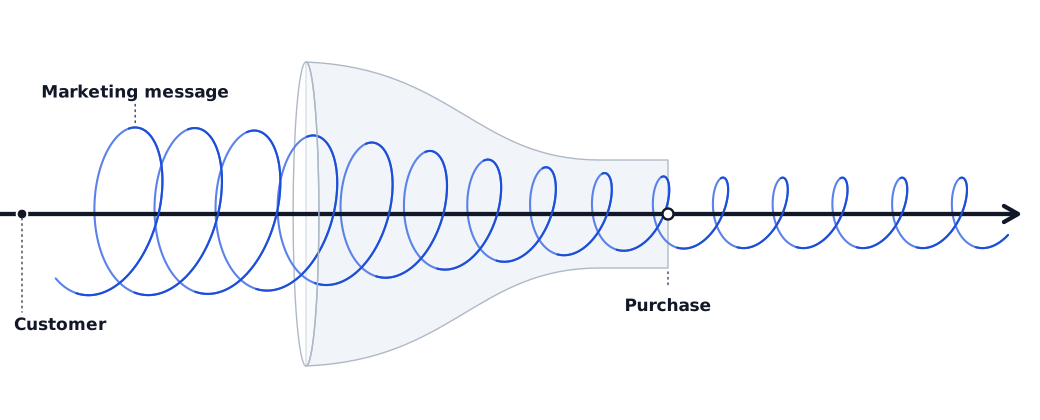
One marketing message orbiting one moving customer through a marketing funnel, drawing closer toward a purchase and continuing after itOne customer is a dark straight line moving left to right; it is already under way at the left edge and ends in an arrow. One blue line orbits it the whole way: a marketing message moving around the customer. A pale marketing funnel lies on its side behind the middle stretch, wide intake on the left, short neck on the right, ending at a point marked purchase. The funnel is partly translucent: inside it the orbit is seen through the funnel, a little fainter, but it is the same unbroken line. The orbit is wide before the funnel, draws gradually closer to the customer, and continues past the purchase at its closest. The funnel does not pull the message in. This is one illustrative journey that ends in a purchase; it does not say every customer buys or that trust always lasts afterward. Purchase Customer Marketing message One marketing message orbiting one moving customer through a marketing funnel, drawing closer toward a purchase and continuing after itOne customer is a dark straight line moving left to right; it is already under way at the left edge and ends in an arrow. One blue line orbits it the whole way: a marketing message moving around the customer. A pale marketing funnel lies on its side behind the middle stretch, wide intake on the left, short neck on the right, ending at a point marked purchase. The funnel is partly translucent: inside it the orbit is seen through the funnel, a little fainter, but it is the same unbroken line. The orbit is wide before the funnel, draws gradually closer to the customer, and continues past the purchase at its closest. The funnel does not pull the message in. This is one illustrative journey that ends in a purchase; it does not say every customer buys or that trust always lasts afterward. Purchase Customer Marketing message One marketing message orbiting one moving customer through a marketing funnel, drawing closer toward a purchase and continuing after itOne customer is a dark straight line moving left to right; it is already under way at the left edge and ends in an arrow. One blue line orbits it the whole way: a marketing message moving around the customer. A pale marketing funnel lies on its side behind the middle stretch, wide intake on the left, short neck on the right, ending at a point marked purchase. The funnel is partly translucent: inside it the orbit is seen through the funnel, a little fainter, but it is the same unbroken line. The orbit is wide before the funnel, draws gradually closer to the customer, and continues past the purchase at its closest. The funnel does not pull the message in. This is one illustrative journey that ends in a purchase; it does not say every customer buys or that trust always lasts afterward. Purchase Customer Marketing message

Now the marketing messages. The customer is the straight line, already in motion. A marketing message moves around that customer: far out at first, drawing closer as trust, relevance, and timing align, and still there after the purchase. That moving message is the Helix. The funnel tracks the process; the Helix shows what the marketing is doing around the customer inside it. This is one illustrative path that ends in a purchase. It does not say every customer buys.

↓ Download SVG
04 of 24

Customer in Motion: Most Messages Drift Past

Framework Overview
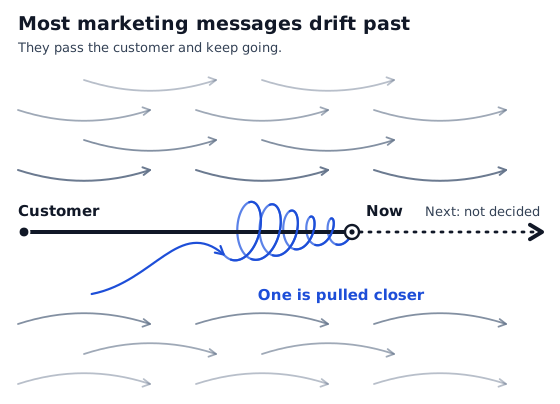
Most marketing messages drift past a customer in motion; one is pulled closerThe customer is a dark straight line moving left to right; a ring marks now and the line ahead is dashed because what the customer does next is not decided. 18 gray marketing messages fill the picture in lanes above and below the customer, all traveling left to right. Each one passes the customer and keeps going: they drift past. One small blue marketing message orbits the customer and draws closer: it is the only one pulled in. Most marketing messages drift past They pass the customer and keep going. Customer One is pulled closer Now Next: not decided

Most marketing messages drift past. The customer is the straight line, moving left to right, and most of what is aimed at that customer passes by and keeps going. One message is pulled closer. The crowd is an illustration, not a count: it does not claim a ratio, and passing near a customer is not the same as being noticed. The line ahead is dashed because what the customer does next is not decided.

↓ Download SVG
05 of 24

Market in Motion

Framework Overview
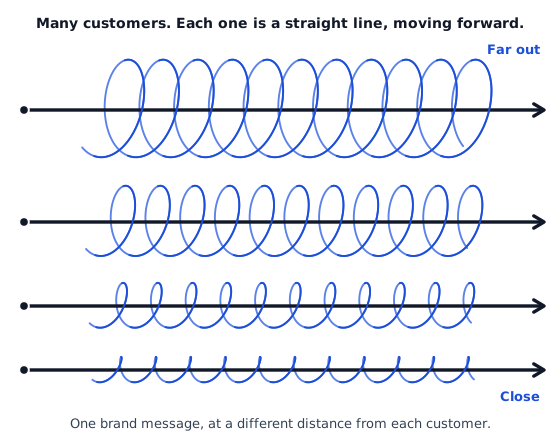
Four customers, each a straight line moving left to right, with the same marketing message orbiting each at a different distanceFour dark straight lines, one above the other, each a different customer moving left to right. The same blue marketing message orbits every one of them. Around the top customer the orbit is wide, far out. Around each lower customer the orbit is closer, and around the bottom customer it is close. No customer travels along the orbit. Many customers. Each one is a straight line, moving forward. Far out Close One brand message, at a different distance from each customer.

Many customers, each a straight line moving forward. One brand message sits at a different distance from each of them: far from one, close to another. It stands for the brand's signal, not for one identical ad reaching everyone. Audiences, exposure and category all differ. No customer travels the orbit.

↓ Download SVG
Group 02

Attention

06 of 24

More Messages Does Not Mean More Attention

Attention
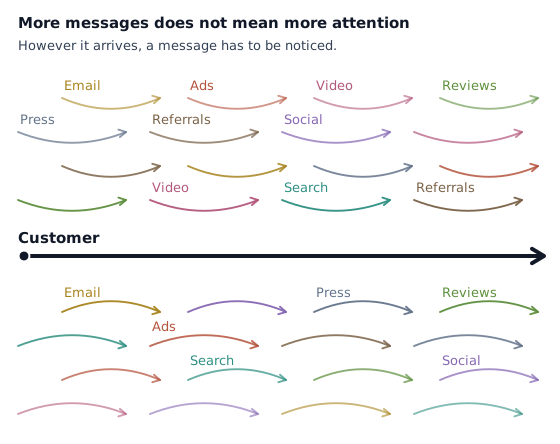
More messages does not mean more attention: many kinds of marketing message stream past a customer and none is noticedThe customer is a dark straight line moving left to right. The rest of the drawing is filled with marketing messages, 32 of them in lanes above and below the customer, all traveling left to right. They are of eight kinds, named on the arrows: ads, search, social, email, video, reviews, referrals, press. The kinds are mixed together through the stream, each in its own muted color. Every message passes the customer and keeps going. None reaches the customer's line and none is noticed. The customer's line continues untouched. More messages does not mean more attention However it arrives, a message has to be noticed. Email Ads Video Reviews Press Referrals Social Video Search Referrals Email Press Reviews Ads Search Social Customer

A company can put out a flood of marketing: ads, search results, social posts, email, video, reviews, referrals, press. Making a hundred videos does not mean anyone sees them. Paid, earned, or organic, none of it is attention until the customer looks. Color only tells the kinds apart, and each kind is also named. Blue is kept for the message that is noticed.

↓ Download SVG
07 of 24

Being There Is Not Being Noticed

Attention
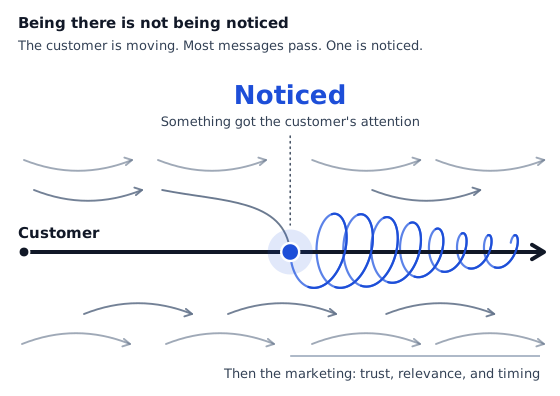
Being there is not being noticed: marketing messages are around a moving customer, most of them pass, and one is noticedThe customer is a dark straight line moving left to right. Gray marketing messages travel left to right above and below the customer, along the whole length of the drawing. Each one passes the customer and keeps going: it is not noticed. One gray message comes down to the customer's line. Where it meets the line there is a large solid blue dot under the word Noticed, the largest word in the drawing: something got the customer's attention. From that dot the same message is blue and begins to turn around the customer, a little closer with each turn. Gray messages keep passing after it. A line under the blue part is labeled: then the marketing, trust, relevance, and timing. The messages were already there, around the customer. Being there is not being noticed, and being noticed is not a purchase. Being there is not being noticed The customer is moving. Most messages pass. One is noticed. Noticed Something got the customer's attention Customer Then the marketing: trust, relevance, and timing

The customer is moving. Something shakes them. It gets their attention. It hooks them. Most marketing messages pass without that; one is noticed, and only from that point can trust, relevance, and timing matter. Being noticed is not being chosen.

↓ Download SVG
08 of 24

Noticed Is Not Chosen

Attention
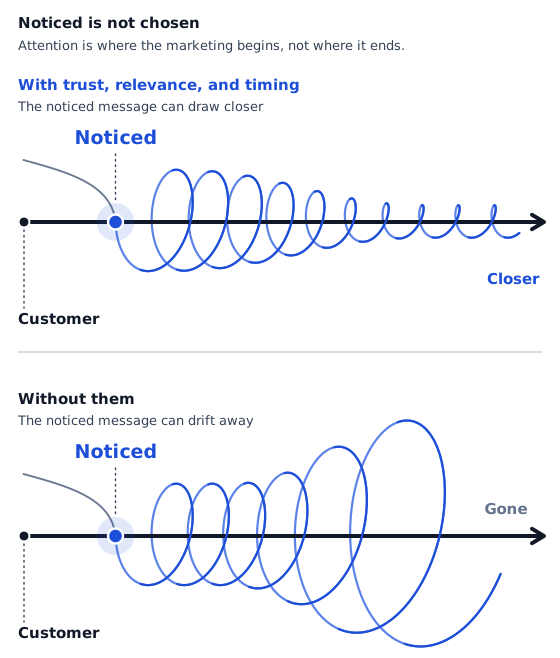
Noticed is not chosen: after the same moment of attention, a marketing message can draw closer to the customer or drift awayTwo rows. In each, the customer is a dark straight line moving left to right, and one gray marketing message comes down to the customer's line, where a solid blue dot marks the moment it is noticed. From that dot the message is blue and begins the same wide turn around the customer. Top row, with trust, relevance, and timing: the message can draw closer with every turn. Bottom row, without them: each turn can be wider and fainter than the one before, and then the message is gone while the customer keeps moving. These are two possibilities, not the only outcomes. Being noticed is where the marketing begins, not a purchase. Noticed is not chosen Attention is where the marketing begins, not where it ends. With trust, relevance, and timing The noticed message can draw closer Customer Noticed Closer Without them The noticed message can drift away Customer Noticed Gone

Being noticed is not being chosen. Once a message is noticed, trust is the first test, and trust, relevance, and timing shape whether the message draws closer or drifts away. These are two possibilities, not the only outcomes.

↓ Download SVG
Group 03

The Three Forces

09 of 24

The Three Forces

The Three Forces
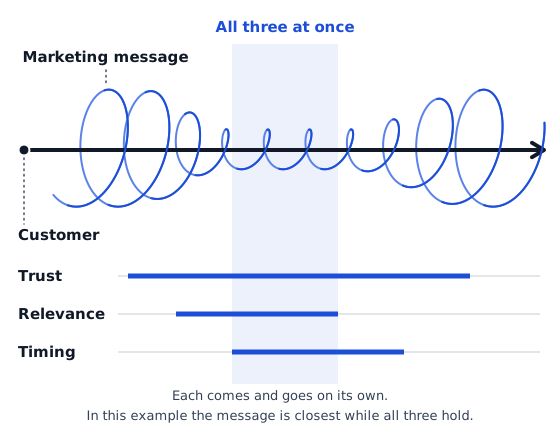
Trust, relevance and timing each present for a different stretch; the marketing message is closest to the customer only where all three overlapThe customer is a dark straight line moving left to right, with one blue marketing message orbiting it. Below, three bars show when trust, relevance and timing are each present. They start and stop at different times. In the shaded stretch where all three overlap, the orbit is at its closest to the customer. Before and after it, the orbit is wide. Customer Marketing message Trust Relevance Timing All three at once Each comes and goes on its own. In this example the message is closest while all three hold.

Trust, relevance, and timing each come and go on their own schedule. In this example the message is closest to the customer while all three hold at the same moment. The three are conditions that affect response. They are not shown to be necessary or sufficient for every purchase.

↓ Download SVG
10 of 24

The Alignment Moment

The Three Forces
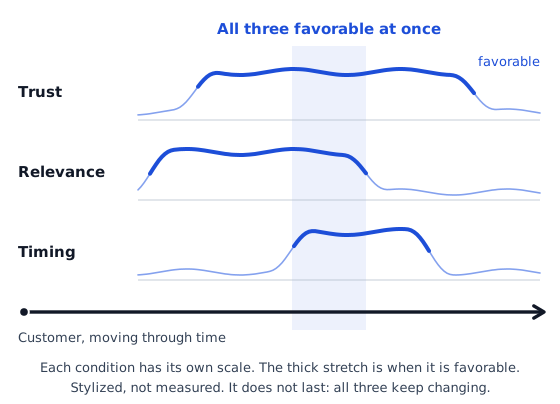
Trust, relevance and timing each favorable for a different stretch of time, with a shared window where all three are favorable at onceThree separate tracks, one each for trust, relevance and timing, run left to right above a dark line that is the customer moving through time. Each track is a thin wandering line with one thick stretch that marks when that condition is favorable. The thick stretches begin and end at different times. A shaded vertical band marks the window of time in which all three thick stretches overlap. The three tracks are not on a common scale and never have to reach the same value. All three favorable at once Trust favorable Relevance Timing Customer, moving through time Each condition has its own scale. The thick stretch is when it is favorable. Stylized, not measured. It does not last: all three keep changing.

Each condition has its own track and its own scale. What matters is the stretch of time in which all three are favorable at once, not any point where three values are equal. It does not last, because all three keep changing. The shapes are stylized. Nothing here is measured.

↓ Download SVG
11 of 24

Alignment Decays Quietly

The Three Forces
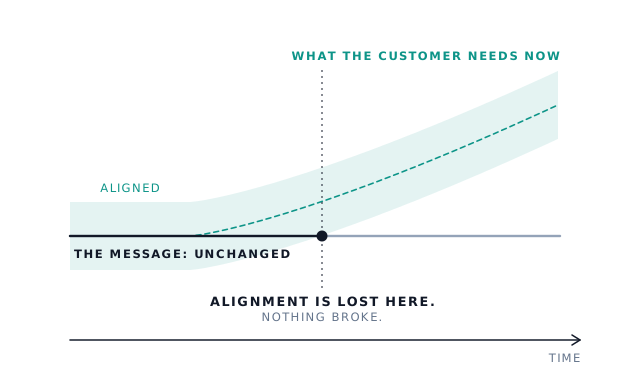
A message that stays exactly where it was while what the customer needs drifts away from it, until the two no longer alignA chart over time. The message is a straight dark line that never moves. What the customer needs now is a dashed teal line inside a shaded band. At the left the message runs through the middle of the band: aligned. Over time the band drifts steadily upward, away from the message. At one point the message leaves the band: alignment is lost here, and nothing broke. Past that point the message line is gray. ALIGNMENT IS LOST HERE. NOTHING BROKE. THE MESSAGE: UNCHANGED WHAT THE CUSTOMER NEEDS NOW ALIGNED TIME

One scenario: the message has not changed, and what the customer needs has moved. Alignment is lost at the marked point, and nothing broke.

↓ Download SVG
Group 04

Trust

12 of 24

Orbit Tightening

Trust
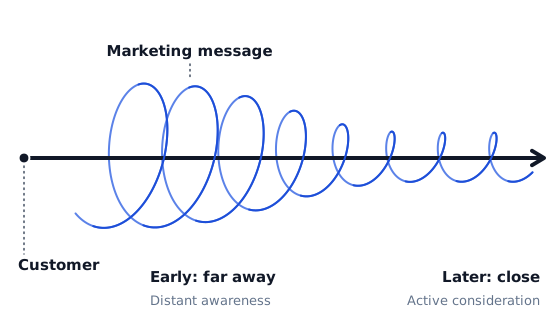
One marketing message orbiting one customer, far away at first and closer over timeThe customer is a dark straight line moving left to right. One blue marketing message orbits it. On the left the orbit is wide: far away, distant awareness. Moving right the orbit draws steadily closer to the customer: active consideration. Customer Marketing message Early: far away Distant awareness Later: close Active consideration

Where credible signals reinforce one another, the orbit can contract and the message moves from distant awareness toward active consideration. Closeness here is a picture of alignment, not a measured distance, and nothing requires the stages to arrive in this order.

↓ Download SVG
13 of 24

Trust Compounding

Trust
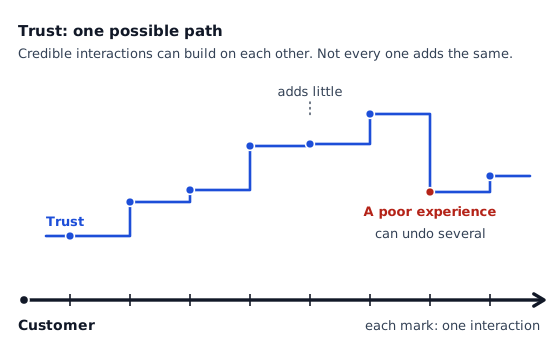
One illustrative path of trust over time: gains of different sizes, one interaction that adds little, a poor experience that takes several back, and a partial recoveryA blue stepped line shows trust over time above a dark line that is the customer moving left to right; each tick on the customer's line is one interaction. The steps rise by different amounts: some large, some small, and one adds almost nothing. At one interaction, marked in red as a poor experience, the line drops by more than the last two gains together. The next interaction recovers part of it. This is one possible path, not a rule: nothing here says every credible interaction adds more than the one before. Customer each mark: one interaction Trust: one possible path Credible interactions can build on each other. Not every one adds the same. Trust adds little A poor experience can undo several

One possible path. Credible interactions can build on each other, and they do not all add the same: some add a lot, some add little. A poor experience can take back more than the last gain. Nothing here says every interaction adds more than the one before.

↓ Download SVG
14 of 24

Trust Decay

Trust
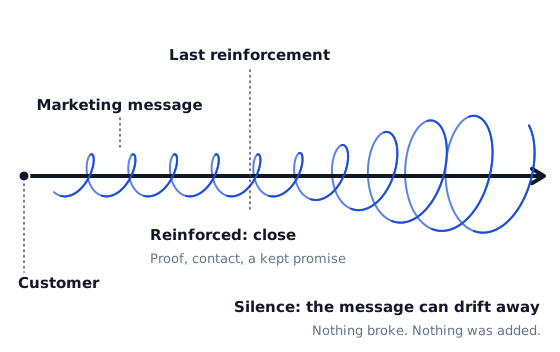
A marketing message orbiting close to a customer, then drifting away and fading after the last reinforcementThe customer is a dark straight line moving left to right. A blue marketing message orbits close to the customer while trust is being reinforced. A dotted marker shows the last reinforcement. After it, with silence, each turn of the orbit is wider and fainter than the one before: the message drifts away. Last reinforcement Customer Marketing message Reinforced: close Proof, contact, a kept promise Silence: the message can drift away Nothing broke. Nothing was added.

One scenario: past the last reinforcement, the message can drift wider with every turn. Silence can weaken a signal. It does not always: memory, habit and good delivery can hold a brand in place for a long time without new messages.

↓ Download SVG
Group 05

Relevance and Timing

15 of 24

Scattered and Focused

Relevance and Timing
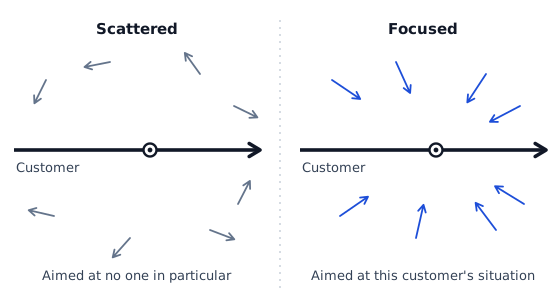
Scattered messages point in every direction; focused messages point at the customerTwo panels. In each, the customer is a dark line moving left to right with a ring marking where the customer is now. Left, scattered: eight gray message arrows point in unrelated directions and none points at the customer. Right, focused: eight blue message arrows all point at the customer. Scattered Customer Aimed at no one in particular Focused Customer Aimed at this customer's situation

The same messages, aimed at no one in particular or aimed at where this customer is now.

↓ Download SVG
16 of 24

Signal Interference

Relevance and Timing
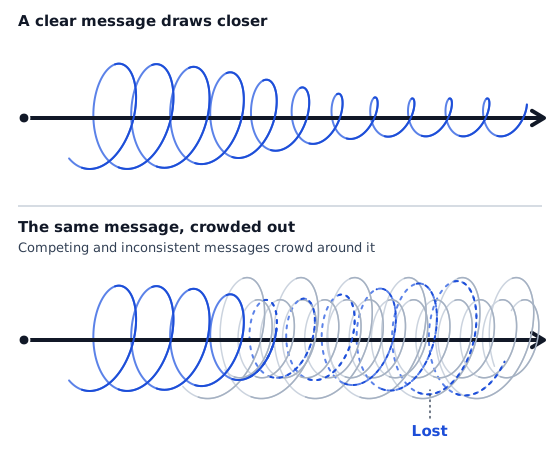
A clear marketing message draws closer to the customer; the same message among competing ones breaks up and is lostTwo rows, each a customer as a dark line moving left to right with a blue marketing message orbiting. Top: a clear message, the orbit draws steadily closer. Bottom: the same message starts the same way, then gray orbits of competing and inconsistent messages crowd around the customer; the blue orbit turns to dashes, stops drawing closer and fades. It is lost. A clear message draws closer The same message, crowded out Competing and inconsistent messages crowd around it Lost

One scenario: a clear message draws closer. The same message, crowded by competing and inconsistent ones, is lost.

↓ Download SVG
17 of 24

The Readiness Window

Relevance and Timing
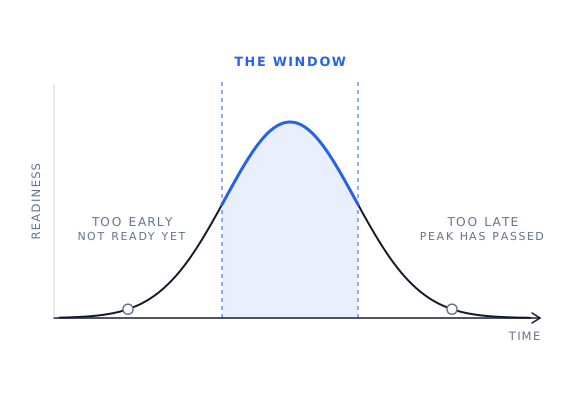
The customer's readiness rising to a peak and falling, with a short shaded window around the peakA curve of readiness over time: it rises to a peak and falls. A shaded window, bounded by two dashed lines, marks the short interval around the peak. A marker on the rising side is labeled too early, not ready yet. A marker on the falling side is labeled too late, the peak has passed. TIME READINESS THE WINDOW TOO EARLY NOT READY YET TOO LATE PEAK HAS PASSED

An example of timing: the customer's readiness rises to a peak and falls, and a message that arrives before or after the window misses it. Real windows vary. Some are long, some repeat, some never open, and many depend on events outside the brand's control.

↓ Download SVG
18 of 24

Timing Mismatch

Relevance and Timing
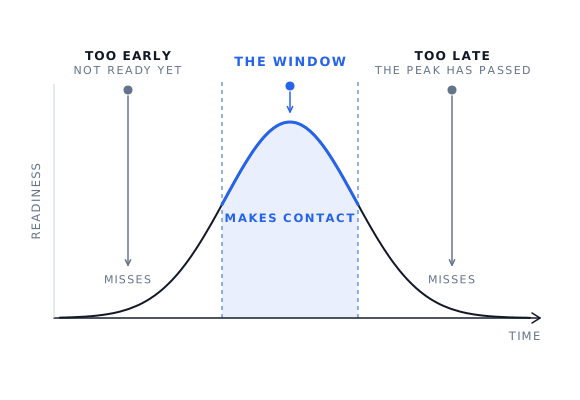
Three messages arriving at different moments on the customer's readiness curve: one too early, one in the window, one too lateA curve of the customer's readiness over time: it rises to a peak and falls. A shaded window marks the interval around the peak. Three messages arrive as arrows from above. The first lands on the low early part of the curve: too early, not ready yet. The second, in blue, lands inside the window and makes contact. The third lands after the curve has fallen: too late, the peak has passed. TIME READINESS THE WINDOW MISSES TOO EARLY NOT READY YET MAKES CONTACT MISSES TOO LATE THE PEAK HAS PASSED

The same example with three messages at three moments. Only the one inside the window makes contact. As above, one narrow peak is an illustration, not a rule for every purchase.

↓ Download SVG
20 of 24

Delivery Is Not Attention

Paid Media
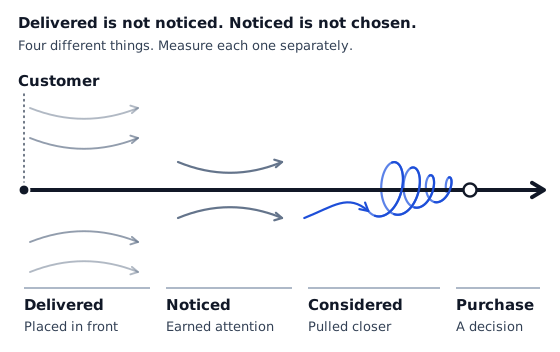
Delivery, attention, consideration and purchase are four different things along a customer's pathThe customer is a dark straight line moving left to right. At the left, several gray marketing messages are delivered and pass by. Next, two pass closer: they are noticed. Next, one blue marketing message arrives as an arrow whose tip becomes an orbit drawing closer around the customer: it is considered. At the right an open ring marks a purchase. Four brackets under the line name the four things: delivered, noticed, considered, purchase. Each is measured separately. Delivered is not noticed. Noticed is not chosen. Four different things. Measure each one separately. Delivered Placed in front Noticed Earned attention Considered Pulled closer Purchase A decision Customer

Four different things along one customer's path: delivered, noticed, considered, purchased. A placement can be bought. Attention, consideration and the decision are earned. Each is measured separately, because a strong number in one says little about the next.

↓ Download SVG
21 of 24

When Paid Media Works

Paid Media
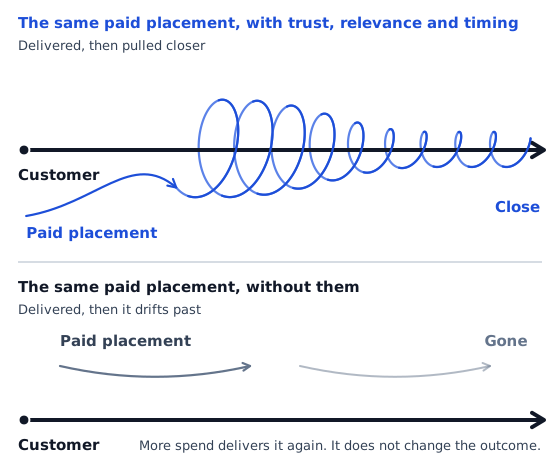
The same paid placement with two outcomes: pulled closer when trust, relevance and timing hold, or drifting past when they do notTwo rows. In each, the customer is a dark straight line moving left to right and one marketing message is delivered by a paid placement. Top row, with trust, relevance and timing: the blue message arrives as an arrow whose tip becomes an orbit around the customer, drawing closer with every turn. Bottom row, without them: the same placement is delivered as a gray message that passes the customer, fades and is gone. Spending more delivers it again; it does not change the outcome. The same paid placement, with trust, relevance and timing Delivered, then pulled closer Customer Paid placement Close The same paid placement, without them Delivered, then it drifts past Customer Paid placement Gone More spend delivers it again. It does not change the outcome.

One scenario, shown twice. The same paid placement reaches the same customer. With trust, relevance and timing it is pulled closer. Without them it is delivered and drifts past, and buying more delivery repeats the result. Advertising can build familiarity and interest; it cannot guarantee them.

↓ Download SVG
22 of 24

When Ad Spend Stops

Paid Media
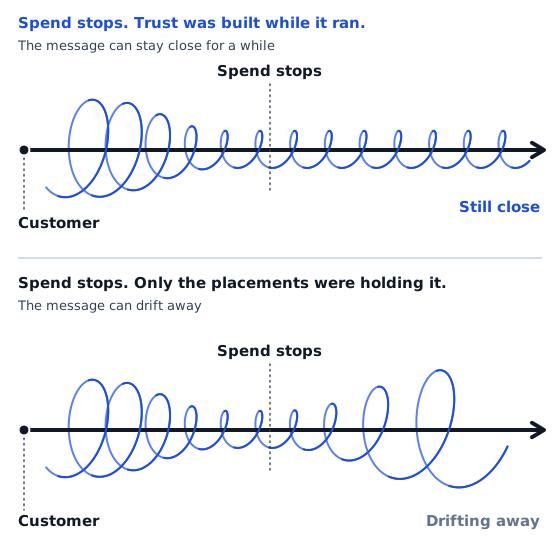
When ad spend stops: a marketing message can stay close if trust was built, or drift away if only the placements were holding itTwo rows. In each, the customer is a dark straight line moving left to right, a blue marketing message orbits close to the customer, and a dotted marker shows where paid spend stops. Top row: trust was built while the spend ran, and after the marker the orbit stays close. Bottom row: only the placements were holding it, and after the marker each turn of the orbit is wider and fainter than the one before. These are two possible examples, not the only outcomes. Spend stops. Trust was built while it ran. The message can stay close for a while Spend stops Customer Still close Spend stops. Only the placements were holding it. The message can drift away Spend stops Customer Drifting away

Two possible examples of what follows when paid spend stops. If trust was built while it ran, the marketing message can stay close for a while. If only the placements were holding it, the message can drift away. Real cases fall between, and other things, such as habit, delivery and reputation, also hold a customer.

↓ Download SVG
Group 07

After the Purchase

23 of 24

The Post-Purchase Helix

After the Purchase
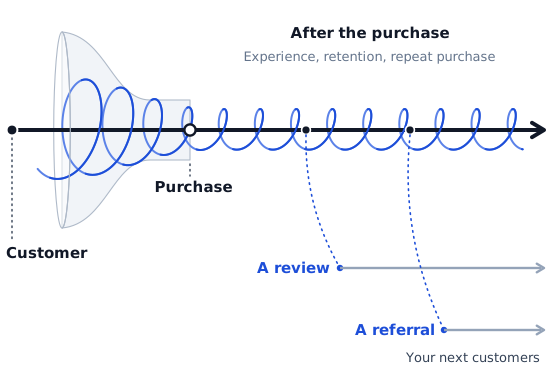
The same marketing message keeps orbiting the customer after the purchase, and the customer's review and referral reach the next customersA pale marketing funnel lies on its side at the left and ends at a ring marked purchase. The customer is a dark straight line that passes through the funnel and keeps moving right after the purchase. One blue marketing message orbits the customer the whole way and stays close after the purchase. From two points on the customer's line after the purchase, dotted lines labeled a review and a referral reach two separate gray lines: the next customers, also moving left to right. Purchase After the purchase Experience, retention, repeat purchase Customer A review A referral Your next customers

The funnel in this picture ends at the purchase. The customer keeps moving and the message stays close. A review or a referral is the customer's own act, not a brand message, and it can reach the next customers. It is a possibility, not a guarantee, and it cannot be manufactured.

↓ Download SVG
24 of 24

After the Sale

After the Purchase
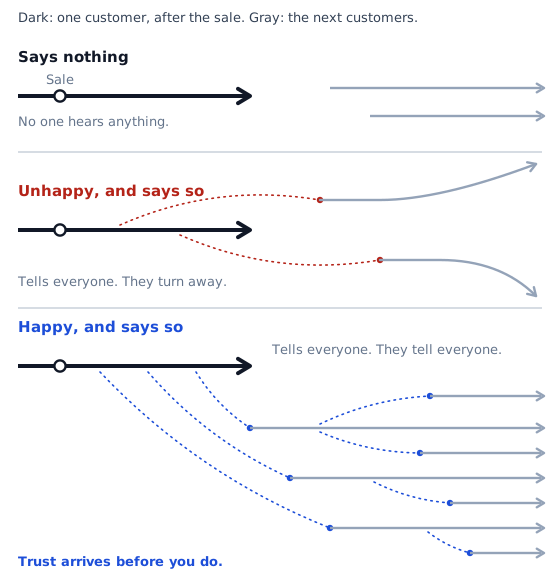
After the sale a customer says nothing, is unhappy and says so, or is happy and says so, and each reaches the next customers differentlyThree rows, each a customer as a dark line moving left to right from a ring marked as the sale, with gray lines for the next customers. Says nothing: no line leaves the customer and the next customers pass by untouched. Unhappy, and says so: red dotted lines reach two next customers, whose lines bend away. Happy, and says so: blue dotted lines reach three next customers, and more dotted lines go from them to further customers, so the influence multiplies. Dark: one customer, after the sale. Gray: the next customers. Says nothing Sale No one hears anything. Unhappy, and says so Tells everyone. They turn away. Happy, and says so Tells everyone. They tell everyone. Trust arrives before you do.

Three possible examples of what follows a sale. One customer says nothing. One is unhappy and tells people. One is happy and tells people, and some of them pass it on. Real customers fall anywhere between, most tell few people or no one, and saying nothing does not mean the experience had no effect.

↓ Download SVG
History

Earlier figures

Figures 02 to 24 run left to right, in the vocabulary of Figure 1. Figure 01 is upright on purpose: it shows the conventional funnel for comparison. The earlier upright figures, the gravity well, push versus pull, and the original diagram set are kept, labeled, in the Model History. They are not the current model.

An applied example

Hypothetical. No client data.

  1. The question. A local service business gets website visits and ranks reasonably in search, and receives few inquiries.
  2. What is observed. With the owner's permission: the business listing shows incomplete hours, service details are out of date, and recent reviews have no reply.
  3. What it might mean. Trust is one candidate. So are price, slow lead handling, location, and low demand. One pattern does not settle the cause.
  4. The smallest change. Correct the listing facts that can be verified, and reply to reviews in a neutral, consistent way. Not a new logo.
  5. How to check. Before the change, record a baseline. Then track profile actions by source and qualified inquiries over a stated window, and note the season. If nothing moves, the reading was wrong: go back to step three.

The funnel, the CRM and the agency all stay. The Helix adds one question to them: are the signals around this customer credible, relevant and on time, and what is the smallest thing that would change that?

Relationship to existing research

The Marketing Helix did not discover that customer journeys are non-linear, that brand memory matters, that trust influences purchase, or that word of mouth exists. It builds on work that did. What it offers is one integrated picture and a way of asking diagnostic questions with it. It is an explanatory proposal. It has not been independently tested.

How the words are used here. A figure illustrates a possible relationship. Nothing on this page is described as observed, tested or validated, because no study of this model has been published.

All diagrams use the site palette: #111827 · #2563EB · #7C3AED · #14B8A6 · #9CA3AF · #D1D5DB
Inline SVG: each diagram embeds directly in any page. Downloads are the same SVG files.