Three combinations, all of which occur
Agile but poorly adaptive. The most common of the three in well-resourced teams. Sprints run cleanly, the board is current, work ships every two weeks, and nobody has asked in eighteen months whether the positioning the work expresses still matches what buyers care about. The velocity is real. The direction has not been examined, because no ceremony in the process owns that question.
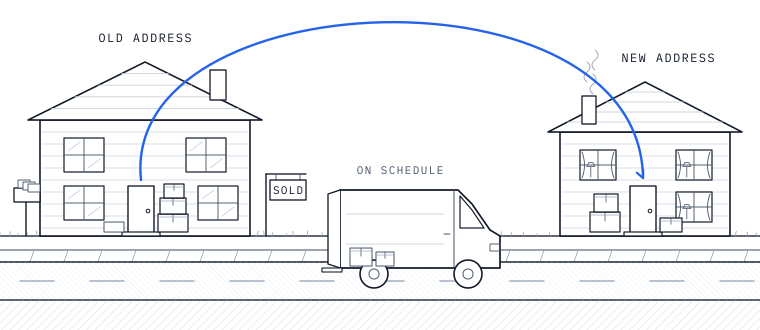
Adaptive without formal agile methodology. Common in small businesses and in senior teams that have been together a long time. There is no board and no sprint. There is somebody who talks to customers weekly, notices when the questions change, and is willing to change the plan. This is genuine adaptation, and its characteristic weakness is that it lives in one person's head, so the organization cannot tell which of its changes worked.
Both. The two compound, because agility shortens the interval between deciding to adapt and having adapted. The value of a signal decays: an insight about a shifting objection is worth considerably more in the week it appears than in the quarter it finally reaches a brief. Agile practice is the most reliable way of shortening that interval, which is why the pairing is worth having even though neither requires the other.
Why the confusion persists
Both involve changing things often, and from outside a single organization the two look identical in any given week. The distinguishing evidence is not the rate of change but what preceded it. An adaptive change names the condition that moved and states what it should shift. An agile change names a backlog item.
There is also a vocabulary problem. Agile practice uses the word adapt in its own manifesto, meaning responding to changes in requirements and in the work. That is a different referent from adapting to a change in the market, and the shared word does a lot of quiet damage.
What this means in practice
If marketing is slow to reach the market and impossible to correct once launched, the problem is probably agility, and agile practices address it directly.
If marketing reaches the market quickly and performance is drifting for reasons nobody can name, the problem is probably adaptive, and no amount of process improvement will touch it. The specific thing usually missing is ownership of the interpretation step: somebody accountable for deciding which observed changes matter enough to act on. Sensing is usually distributed across analytics, sales, and support. Response is usually distributed too. Interpretation is the step with no deliverable, which is why it is the one that ends up belonging to nobody.