What getting through means
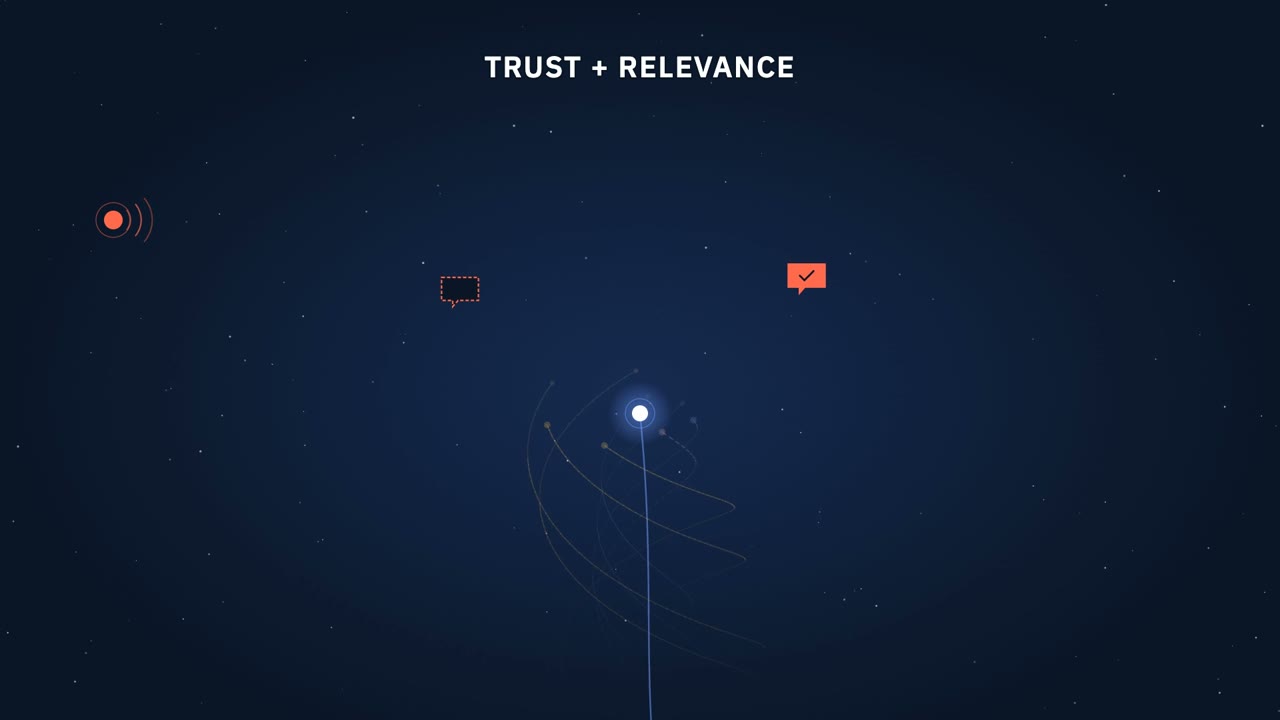
Reaching a customer and getting through to them are different events. Delivery puts a message in front of someone. Getting through, in the Marketing Helix, means the message is pulled into active consideration: the customer evaluates it, engages with it, and moves toward a decision. Most delivered messages never make that transition, because customers in motion meet far more messages than they could ever consider.
The model describes that transition as a pull from the customer's side. When a message carries trust, relevance, and timing together, the customer draws it closer. The framework calls this signal gravity. It is an explanatory term, not a claim about physics, and it names where the energy comes from: the customer's own attention, not the force of the send.
The order a message is judged in
The three forces are independent, but they act on a message in a recognizable order. Trust comes first. It is the permission condition: whether the customer allows the source into consideration at all. A message from a source the customer does not yet trust is filtered before it is evaluated, usually without the customer deciding anything consciously. Relevance and timing never get a chance to matter.
Relevance comes next. It is the state-match condition: whether the message fits where the customer actually is in their own thinking. A careful comparison of options is irrelevant to someone still deciding whether they have a problem, and problem framing is irrelevant to someone choosing between two vendors. Relevance belongs to the fit between message and customer, not to the message itself.
Timing is the convergence condition. It asks whether trust and relevance meet while the customer is ready to act. A trusted, relevant message that arrives before readiness may add a little to trust but produces no decision. One that arrives after the customer has already chosen produces no opportunity at all.
Why two out of three is not enough
The forces behave as simultaneous thresholds, not as scores that add up. A message strong on trust and relevance but outside the readiness window does not get two thirds of a result. It gets none. This is the central structural claim of the Marketing Helix, and it is what makes the model useful in practice: when results fall, the question becomes which gate the message is failing.
Each failure has a signature. Plenty of engagement with little conversion usually means timing: people trust the source and find the material relevant but are not yet deciding. Strong conversion in one narrow segment that will not spread usually means trust has not been extended to the wider audience. Messages that are trusted and timely but ignored usually mean relevance: the material answers a question the customer has already moved past, or has not reached.
None of the gates holds still. Trust strengthens or decays, the customer's question moves, and readiness rises and falls on its own schedule. A message that got through last quarter can stop getting through without a single word changing. The full account of each force, and how each is built or lost, is on the Three Forces page.
Where this does not hold
The three gates describe when a message is pulled into consideration, not whether the customer finally buys. Price, availability, and the offer itself still decide the last step. The diagnostic signatures above are patterns to test, not verdicts: a team should state which gate it believes is failing and check that prediction before acting on it.
More from The Marketing Helix
 0:58What replaced the marketing funnel?
 0:19Why does the marketing funnel leak?
 0:16Why is marketing shaped like a helix, not a funnel?
Questions
What makes a marketing message get through to a customer?
In the Marketing Helix, a marketing message gets through only when trust, relevance, and timing clear their thresholds at the same moment. The customer must trust the source, the message must fit their current question, and it must arrive while they are ready to act. If any one of the three is missing, the message drifts past regardless of its quality.
Why is trust the first gate in the Marketing Helix?
Trust is the first gate in the Marketing Helix because a message from a source the customer does not trust is filtered before it is evaluated. The customer never judges its relevance or timing. That is why credibility work is not a late-stage activity in the Marketing Helix: it decides whether anything that follows is read at all.
What is the gravity in the Marketing Helix?
The gravity in the Marketing Helix is signal gravity: the pull a customer exerts on a message that carries trust, relevance, and timing together. The customer draws an aligned message closer rather than the brand forcing it through. It is an explanatory term for customer behavior, not a physical claim, and it occurs only when all three forces align.
Transcript
Three forces decide what gets through. Trust, relevance, and timing. When a message has all three, the customer pulls it closer. That pull is the gravity. The model for customers in motion.
Narration is a synthetic voice.