
Compounding inside one relationship
The Marketing Helix describes trust as accumulating across interactions rather than being produced by any single one. Each credible experience can strengthen the meaning of the ones before it, so the customer's trust baseline rises and the next encounter starts from a higher position. That is compounding within a single relationship: the same message is received differently by a customer who has been treated well for a long time than by one who has not.
This is also why the model describes a helix rather than a loop. A loop returns to the same point with each turn. A helix advances, so an aligned interaction does not simply repeat a previous outcome; it can build on it.
Compounding across customers
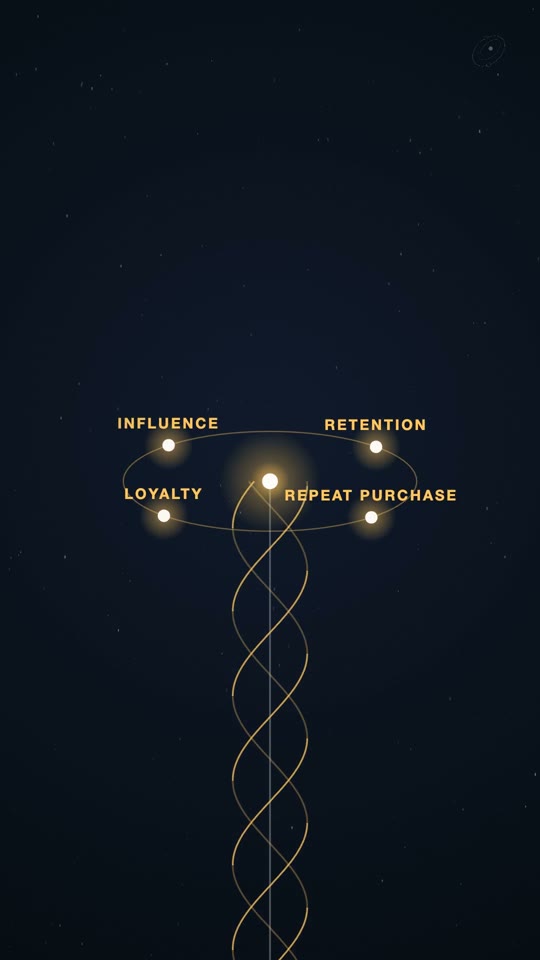
The more distinctive form of compounding happens between people. When a customer who trusts a brand recommends it, reviews it, or mentions it in conversation, their trust enters the information environment and reaches customers in motion whom the brand has never met.
Consider what that recommendation carries. The trust force is largely satisfied, because it comes from someone the listener already trusts. The relevance force is largely satisfied too, because the recommender usually knows the listener's situation and speaks to it directly. What remains is timing: whether the listener is ready to act. When they are, the recommendation is pulled in with little resistance. When they are not, it often stays with them until they are, which is a kind of presence a brand's own message rarely achieves.
Across many customers, this raises the ambient trust baseline for the whole brand. New prospects arrive with part of their trust threshold already met by people who came before them, and the brand operates from a higher starting point at every new encounter than a brand without that base of advocates.
Compounding runs in both directions
The model is explicit that trust can compound or decay. Contradiction, silence, outdated information, or a poor experience can interrupt the gains or reverse them. Trust is asymmetric: built slowly through consistent positive inputs and reduced quickly by a single salient negative one.
The cross-customer mechanism reverses too. A dissatisfied customer's account reaches new prospects the same way a satisfied customer's does, and it tends to arrive without being prompted. A negative experience does not only cost one relationship; it raises the trust threshold for people who have not yet met the brand. That is why the Post-Purchase Helix treats the quality of the post-sale experience as part of acquisition rather than a separate concern.
Where this does not hold
Compounding is a possibility, not a guarantee. It depends on signals staying consistent and current, and it stops when they do. A recommendation also does not override a real mismatch: if the product does not suit the listener, borrowed trust will not make it relevant. And the model does not claim a rate or a multiplier for the effect; it describes the direction, not the size.
More from The Post-Purchase Helix
 0:45What happens to the customer after the sale?
 0:15Is the sale the end of the customer journey?
 0:16What changes for a customer after they buy?
 0:14What can one purchase turn into?
Questions
How does customer trust compound?
In the Marketing Helix, customer trust compounds in two ways. Within one relationship, each credible experience raises the trust baseline for the next encounter. Across customers, people who trust a brand pass that trust on through recommendations and reviews, so new prospects arrive with part of their trust already in place before the brand reaches them.
Why is a recommendation so effective in the Marketing Helix?
In the Marketing Helix, a recommendation arrives already trusted, because it comes from someone the listener believes, and already relevant, because the recommender usually knows the listener's situation. Of the three forces, trust, relevance, and timing, only timing is left to align, which is why recommendations are pulled into consideration so readily.
Can trust compound in the wrong direction?
Yes. The Marketing Helix holds that trust can compound or decay. A poor experience reduces trust quickly, and a dissatisfied customer's account reaches new prospects the same way a recommendation does, often without being prompted. That raises the trust threshold for customers the brand has not yet met.
Transcript
And trust compounds. Customers who trust you influence new potential customers. The customer never stopped moving. This is the Marketing Helix. The model for customers in motion.
Narration is a synthetic voice.